
Foam Blanket for the Etching Press
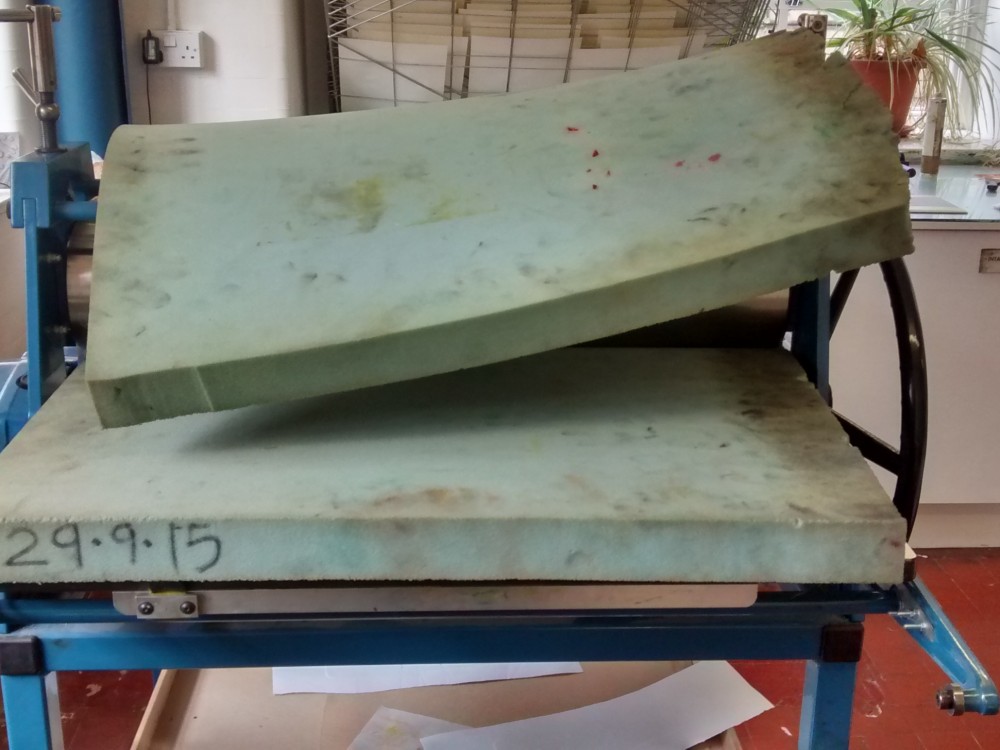
This is a foam blanket, bought from Langans on Fore Street. You can see the date when it was purchased written on the end. So the Studio Manager knows how long it has been used for before it is replaced. This one is getting quite manky, but its still good. When the blanket is new it behaves differently to when it is 'bedded' in. We have to adjust the pressure on the press accordingly.
Where and how is it used?
It is used on the etching press at Double Elephant Print Workshop. Traditionally wool blankets are used on etching presses - three to be precise, and they have different names: sizing catcher, cushion and pusher. "Etching felts are used in sets of three on the etching press, and provide the cushion that creates embossment by pressing the paper into the recesses of the plate. Each blanket serves a different purpose and is therefore a different thickness, and is either woven felt or pressed felt." (http://www.takachpress.com/access/blankets.htm).
Why do we use a foam blanket? Because is is much much cheaper. About £40, instead of hundreds of pounds. Double Elephant is for printmakers of all different levels and experience. We teach a lot of beginners. We like to be friendly and accessible. Sometimes, new learners get something called 'printing fever' (not sure if this is an official term) and occasionally forget the paper, meaning the inky plate is printed directly onto the blanket... Because we want them to return, and because we don't want to bankrupt our minor margins, the foam blanket is a great alternative. However I have heard that foam doesn't degrade. This isn't in keeping with our ethical approach.
What did you or someone else pay for it?
We did.
Why do you want to add it to the museum?
Because it is a conundrum - one common, I guess, to many organisations trying to be ethical: to be people friendly now? Or threaten people friendliness in the future with non biodegradable material?
How was it made?
Is made in a factory
Is farmed
Is mass-produced
Is produced by local cottage industry
Is made to particular specifications
Is craft / hand-made
Is foraged
Is found
Is colonised
Is a service
Materials & Making
Who made or produced your commodity?
I don't know
Who was paid to make it?
I don't know
What skills does it take to make it?
I don't know
Where was it made?
I don't know
What does it cost to make it?
I don't know
What is it made from?
-
Buying & Owning
Who decides how much it costs?
Not answered yet
Who or what assesses its quality?
Not answered yet
Where is it sold?
Langans in Exeter
Who or what sells it?
Not answered yet
How did this thing arrive from where it was made to where you got it?
Not answered yet
Where is it used?
on the etching press
Where is it kept?
on the etching press
How and by whom is it cared for?
Not answered yet
How long will it last?
about 2 months
Where will it go when it's finished with?
it will be chopped up to make sponges for cleaning
What is it worth?
about £40
How do you and others value this commodity?
See the values contributed by visitors and those of the donor. And add your own values to this commodity.
| Total times valued | 2 |
| Positive (↑) | Consistency |
| Negative (↓) | Amusement |
| Overall Positive | 240 |
| Overall Negative | -20 |
| Controversy | 62 (0 = most controversial) |
What do these numbers mean?
This data that we have collected over time in our database means nothing without interpretation. A relational database, which we are using here, is technology that enables designers of websites and software to compare, contrast, interrogate and infer relations within data. The act of designing a database is not objective but driven by the agency of its creators and owners.
Within the MoCC Collection data is used to help think through the relations between values, commodities and data. Can we describe our values using sliders and numbers? How do we infer meaning such as controversy from data?
Below is a brief explanation of the some calculations and how these help make decisions about what is shown on the site.
-
Controversy Score:
(Total Positive Values) + (Total Negative Values)
The closer the value is to zero the more controversial it is in relation to other commodities. Used to infer that values associated with one commodity divide opinion more than another.
-
Average Value Score (used in the sliders):
(Total Positive for Value + Total Negative for Value) ÷ Total Times Valued
Used to infer a collective value associated with a commodity.
How do you value this commodity?
To add your own values click VALUE THIS COMMODITY and move the sliders left and right to add your own values - then click SUBMITQuestions and answers
Help to reveal unknown quantities, properties and uses of this commodity by answering this MoCC curator's questions.
There are no questions.
Conversation
Do you have questions about how this commodity is valued? Or want to talk about your own values in relation to it? Share your comments.
Add to the conversation:
You must be logged in to post a comment.